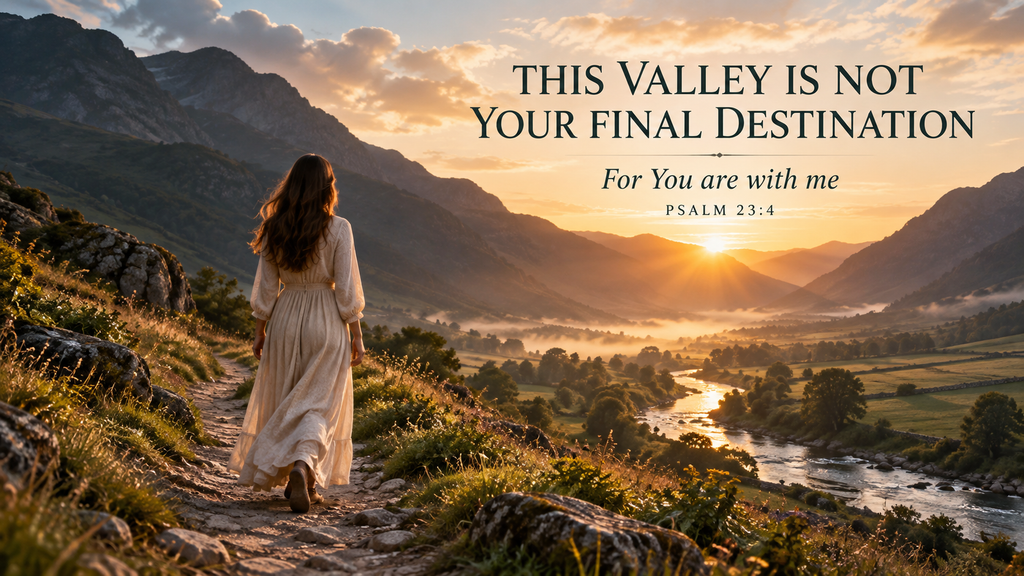
This Valley Is Not Your Final Destination: Finding Hope in Psalm 23:4
“Yea, though I walk through the valley of the shadow of death, I will fear no evil: for thou art with me…” — Psalm 23:4
Some seasons of life feel like mountaintops.
You can see where you are going.
Things make sense.
Prayers seem to be answered.
Doors open.
You feel strong.
And then there are valleys.
The light seems dimmer.
The road is harder to understand.
Things you once felt sure about suddenly feel uncertain.
You may be grieving something you never expected to lose.
Waiting for an answer that has not come.
Walking through disappointment.
Trying to hold onto faith while asking God questions you never thought you would have to ask.
Psalm 23:4 was written for places like these.
David does not pretend the valley is pleasant.
He does not deny the darkness.
He does not say there is nothing to fear.
Instead, he says something far more powerful:
“I will fear no evil: for thou art with me.”
The comfort of Psalm 23:4 is not that valleys never come.
It is that God does not leave us when they do.
And perhaps there is another part of the verse you need to notice today:
David says,
“Though I walk through the valley…”
Not stay forever in the valley.
Not build my identity around the valley.
Not assuming the valley is the end of my story.
He walks through it.
This valley may be part of your journey, but it does not have to become the definition of your life.
What Does Psalm 23:4 Mean?
Psalm 23 is one of the best-known passages in Scripture.
David describes the Lord as a shepherd.
Earlier in the psalm, the shepherd leads His sheep beside still waters and into green pastures.
But then the scenery changes.
The path moves into a dark valley.
That contrast matters.
The same Shepherd who leads beside peaceful waters is still the Shepherd when the road becomes dark.
Psalm 23:4 therefore gives us a deeply realistic picture of faith.
Following God does not mean every part of the journey will feel peaceful.
Sometimes God’s people walk through places they would never have chosen for themselves.
Yet the Shepherd does not disappear when the landscape changes.
Your circumstances can change without God’s presence changing.
That is one of the central messages of Psalm 23:4.
1. The Valley Is a Place You Walk Through
There is something powerful about the wording:
“Though I walk through the valley…”
A valley is not presented as the destination.
It is part of the route.
That does not mean every painful situation will end quickly.
Some valleys last much longer than we expect.
Grief can take time.
Healing can take time.
Financial difficulties can take time.
Rebuilding after disappointment can take time.
Waiting for direction can take time.
And sometimes life changes permanently.
Christian hope should never require us to pretend otherwise.
But there is a difference between saying:
“I am walking through a difficult season”
and saying:
“This difficult season is all my life will ever be.”
Pain often tries to persuade us that today predicts forever.
Psalm 23:4 pushes back against that hopelessness.
Where you are today does not tell you everything about where God may still lead you.
2. Darkness Does Not Mean God Has Abandoned You
When life becomes difficult, one of the first questions we may ask is:
“God, where are You?”
We may understand God’s presence intellectually and still struggle emotionally.
When everything is going well, it can feel easier to believe God is near.
When the answer does not come…
when the relationship ends…
when the opportunity disappears…
when your plans collapse…
when you are exhausted from waiting…
God may suddenly feel distant.
But Psalm 23:4 does not say:
“I walk through the valley because the Shepherd left me.”
It says:
“Thou art with me.”
God is present inside the valley.
A dark season is not proof of God’s absence.
Sometimes the evidence we want from God is immediate escape.
But the comfort He gives first may be His presence.
And His presence is not insignificant.
There are moments when the situation has not changed yet, but something inside you begins to change because you realise:
“I am not carrying this alone.”
3. You Don’t Have to Pretend the Valley Isn’t Dark
Biblical faith is not pretending everything is wonderful.
David called it a valley of deep darkness.
He acknowledged danger.
He acknowledged fear.
And then he chose where to place his confidence.
This matters because Christians can sometimes feel pressure to hide their pain.
Someone asks how you are doing and you say:
“I’m blessed.”
But privately, you are struggling.
You are allowed to tell God the truth.
You can say:
“Lord, I am frightened.”
“I don’t understand this.”
“I am disappointed.”
“I am tired.”
“I don’t know what will happen next.”
Trusting God does not require denying your emotions.
It means bringing those emotions to the One who is walking with you.
Faith is not pretending there is no valley. Faith is refusing to walk through it without God.
4. “I Will Fear No Evil” Does Not Mean You Will Never Feel Afraid
David’s words are courageous:
“I will fear no evil.”
But that does not mean believers never experience fear.
Scripture repeatedly shows faithful people facing frightening situations.
Fear may arrive.
The question is whether fear gets to lead.
There is a difference between feeling afraid and letting fear make every decision for you.
Fear says:
“Nothing good can come after this.”
Faith says:
“I cannot see what comes next, but God is still with me.”
Fear says:
“I have to control everything.”
Faith says:
“I will take the next wise step and trust God with what I cannot control.”
Fear says:
“This valley is where my story ends.”
Faith says:
“This valley is somewhere I am walking through with God.”
5. God’s Presence Can Be More Important Than an Explanation
Most of us want answers.
Why did this happen?
Why did God allow it?
Why hasn’t He changed it?
How long will this last?
Sometimes God gives clarity.
Sometimes understanding comes later.
And sometimes we do not receive the explanation we wanted.
Psalm 23:4 does not give David an explanation for the valley.
It gives him something else:
the Shepherd.
“For thou art with me.”
There may be seasons when the question shifts from:
“God, why am I here?”
to:
“God, help me recognise You here.”
That does not make the pain disappear.
But it changes the way we carry it.
You may not have every answer, but you are not without the Shepherd.
6. The Shepherd Has Not Lost the Path
Sheep do not need to know the entire route.
The shepherd does.
That image is worth remembering when you feel uncertain about your future.
You may not know:
what happens next,
which door will open,
how something will be resolved,
how long the waiting will last,
or what life will look like after this season.
But your inability to see the whole road does not mean God cannot see it.
Psalm 23 is built around the confidence that the Shepherd knows how to lead.
Earlier David says:
“He leadeth me in the paths of righteousness…”
The same Shepherd who leads through green pastures also knows the way through valleys.
You can lose sight of the road without God losing sight of you.
That is a powerful truth to hold onto during uncertain seasons.
7. His Rod and His Staff Comfort Me
David continues:
“Thy rod and thy staff they comfort me.”
A shepherd’s tools represented protection and guidance.
This gives us another dimension of God’s presence.
God does not simply watch from a distance.
The image is of a Shepherd actively caring for His sheep.
Sometimes we want comfort to mean that every threat disappears immediately.
But biblical comfort can also mean knowing:
I am guided.
I am watched over.
I am not abandoned.
I belong to the Shepherd.
And when you cannot see very far ahead, guidance becomes especially precious.
You don’t necessarily need enough light for the next ten years.
Sometimes you need enough light for the next faithful step.
8. Do Not Make Permanent Conclusions in Temporary Darkness
Dark seasons can distort the way we see everything.
A disappointment happens and we think:
“Nothing ever works for me.”
A prayer takes longer than expected and we think:
“God has forgotten me.”
A door closes and we think:
“There will never be another opportunity.”
Someone rejects us and we think:
“I will never belong.”
Those are permanent conclusions formed in moments of pain.
Be careful with them.
The valley changes your view.
It does not necessarily reveal your future.
Do not let a dark chapter write the ending of a story God is still writing.
You do not yet know everything God may do from here.
9. Sometimes God Changes You Before He Changes the Valley
We often pray:
“Lord, get me out of this.”
There is nothing wrong with asking God for deliverance.
David himself prayed for rescue many times.
But sometimes something else happens while we are waiting.
We become stronger.
More discerning.
More compassionate.
Less dependent on people’s approval.
More prayerful.
More aware of what actually matters.
More willing to surrender control.
More attentive to God’s voice.
That does not mean God caused every painful event merely to teach us a lesson.
We should be careful about making claims Scripture does not make about particular tragedies.
But God is able to work within circumstances we would never have chosen.
You may eventually look back and realise:
The valley did not destroy me. God met me there.
10. Keep Walking
David says:
“Though I walk…”
There are seasons when simply continuing is an act of faith.
You may not feel powerful.
You may not feel courageous.
You may not have a dramatic testimony yet.
Sometimes faith looks like:
getting up again,
praying again,
applying again,
forgiving again,
going to church again,
opening your Bible again,
asking for help,
doing today’s work,
and refusing to surrender your hope.
You don’t have to run through the valley.
You don’t have to pretend you enjoy it.
Just keep walking with the Shepherd.
One faithful step.
Then another.
Then another.
What Should You Do When You Are Walking Through a Dark Season?
When you cannot see far ahead, simplify what faithfulness looks like.
Talk honestly to God. Tell Him exactly where you are emotionally.
Stay close to Scripture. Do not allow fear to become the loudest voice in your life.
Take the next faithful step. You do not need every answer today.
Do not isolate yourself. Trusted Christian friends, church leaders or wise people can help you carry difficult seasons.
Remember previous evidence of God’s faithfulness. What has God already brought you through?
Give yourself permission to grieve. Hope and grief can exist together.
Refuse to make hopeless predictions about your future.
And above all:
Remember Who is walking with you.
This Valley Is Not Your Final Destination
Perhaps today you feel like you are standing in one of life’s valleys.
The future looks uncertain.
The light seems far away.
You don’t know how long this season will last.
Psalm 23:4 does not ask you to pretend otherwise.
It simply reminds you:
You are not alone here.
The Shepherd is still your Shepherd.
God did not stop being faithful because the scenery became dark.
He did not lose track of you.
He has not forgotten your name.
You may be walking through something you would never have chosen.
But you are still walking.
The valley is real. But so is God’s presence.
And one day you may look back at this season and realise:
The place where you thought you had been abandoned was one of the places where God taught you most deeply that you were never walking alone.
A Prayer for When You Are Walking Through a Dark Valley
Heavenly Father,
You know the valley I am walking through.
You know the things I am afraid to say aloud, the questions I carry and the parts of my future I cannot see.
Thank You for reminding me through Psalm 23:4 that I do not walk alone.
When fear tells me that this season will never change, help me remember that You are still leading me.
When I cannot understand what You are doing, help me trust Your presence.
Give me courage for today’s step.
Protect my heart from hopelessness.
Guide me with Your wisdom.
Comfort me when I am tired.
And help me remember that darkness does not mean You have left me.
I place this valley, my future and everything I cannot control into Your hands.
Lead me, Shepherd.
In Jesus’ name, Amen.
Frequently Asked Questions About Psalm 23:4
What is the meaning of Psalm 23:4?
Psalm 23:4 expresses David’s confidence that God’s presence, protection and guidance remain with him even during frightening and difficult seasons. The valley represents danger and deep darkness, but David’s confidence rests in the Shepherd who accompanies him.
What does “the valley of the shadow of death” mean?
The phrase describes a place of deep darkness and danger. It can communicate mortal danger but also functions more broadly as imagery for threatening or deeply distressing circumstances.
Why does Psalm 23:4 say “walk through” the valley?
The wording presents the valley as part of the journey rather than the destination. It does not promise that every hardship will be brief, but it gives a picture of continued movement under the Shepherd’s care.
Does Psalm 23:4 mean Christians should never feel afraid?
No. The verse is not a denial of human emotion. It expresses confidence in God in the presence of danger. A believer can feel fear while still choosing to trust God rather than allowing fear to control every decision.
What does “thy rod and thy staff they comfort me” mean?
The imagery comes from shepherding. The rod and staff represent the shepherd’s protection, direction and care. David finds comfort in knowing that God is not merely present but actively watching over and guiding him.
How can I apply Psalm 23:4 when I am struggling?
Pray honestly, remain grounded in Scripture, seek support rather than isolating yourself, take the next wise step available to you and remind yourself that difficult circumstances are not evidence that God has abandoned you.
We are sure you will enjoy the following articles and it will encourage you to continue to put your trust in God: