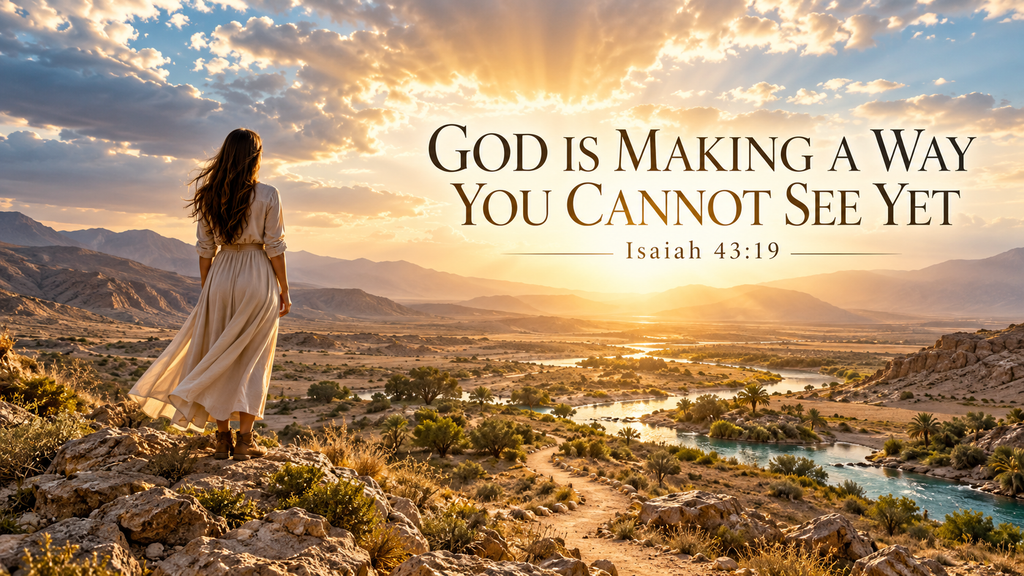
God Is Making a Way You Cannot See Yet: Finding Hope in Isaiah 43:19
“Behold, I will do a new thing; now it shall spring forth; shall ye not know it? I will even make a way in the wilderness, and rivers in the desert.” — Isaiah 43:19 (KJV)
There are seasons when you would give almost anything just to know what happens next.
You have prayed, but the answer is not clear.
You have waited, but nothing seems to be changing.
The door you expected to open remains closed.
The plan you were confident about has fallen apart.
And when you look ahead, instead of seeing a clear road, all you see is uncertainty.
It can feel like standing in a wilderness without a map.
Yet Isaiah 43:19 gives us a beautiful picture of God’s ability to work precisely in places where we cannot see a way forward.
God says:
“Behold, I will do a new thing.”
Then He gives two extraordinary pictures:
a way in the wilderness
and
rivers in the desert.
Both are things you would not naturally expect to find.
A wilderness does not normally provide an obvious road.
A desert does not naturally produce rivers.
And perhaps that is part of the message we need to hear:
God is not limited by what appears possible from where you are standing.
You may not see the way yet.
That does not mean God has no way.
What Does Isaiah 43:19 Mean?
Isaiah 43:19 is often quoted as a promise about new beginnings, and there is certainly hope and renewal in the verse.
But understanding its original context makes it even more powerful.
In Isaiah 43, God is speaking to His people about deliverance.
The verses immediately before Isaiah 43:19 recall God’s past act of bringing His people through the sea. Then God tells them not to remain fixated on the former things because He is going to do something new. The promised deliverance is pictured as a new exodus: God making a road through wilderness and providing water in barren land. In other words, God was reminding His people:
“You know what I have done before. But do not assume that what I do next must look exactly like what I did before.”
That is an important lesson for us too.
Sometimes we know God has helped us before, but we become so attached to the way He helped us before that we struggle to recognise something different.
We pray:
“God, open this door again.”
“Bring this person back.”
“Restore this exact opportunity.”
“Make things return to the way they used to be.”
But sometimes God is not taking us backwards.
Sometimes He is leading us somewhere new.
1. God Can Be Working Before You Can See the Result
One of the most beautiful parts of Isaiah 43:19 is this:
“Now it shall spring forth; shall ye not know it?”
Some translations convey the idea that the new thing is already beginning or springing up.
Think about a seed beneath the soil.
For a while, someone looking at the ground sees nothing.
The surface appears unchanged.
But beneath it, something may already be happening.
Roots are forming.
Growth has begun.
Life is pushing upward.
Then suddenly something appears above the ground.
What became visible that morning did not necessarily begin that morning.
And life can sometimes feel the same way.
You pray and see nothing.
You obey God and see nothing.
You keep going and see nothing.
You wonder whether anything is changing.
But absence of visible progress does not automatically mean absence of progress.
There are things God may be doing that you cannot yet see.
He may be changing circumstances.
He may be preparing you.
He may be closing something that would have harmed you.
He may be developing patience, wisdom or discernment in you.
He may be arranging something very differently from what you expected.
We should be careful not to claim that every disappointment guarantees a particular earthly breakthrough.
Isaiah 43:19 is not a blank cheque promising that every job, relationship, financial problem or personal ambition will turn out exactly as we want.
But it does reveal something dependable about God’s character:
God is able to create possibilities where His people can see none.
2. A Wilderness Is Not Proof That God Has Abandoned You
A wilderness is not somewhere most of us would voluntarily choose.
It represents difficulty.
Uncertainty.
Limited resources.
Few obvious directions.
And sometimes our lives feel exactly like that.
Perhaps you are between jobs and don’t know where the next opportunity will come from.
Perhaps something you spent years building has ended.
Perhaps a relationship changed unexpectedly.
Perhaps you had a clear picture of what this stage of your life would look like, and reality looks nothing like it.
Perhaps you simply feel spiritually tired and cannot understand what God is doing.
It is tempting to interpret difficult terrain as evidence that we have been forgotten.
But Isaiah 43:19 places God in the wilderness.
He says:
“I will even make a way in the wilderness.”
Notice what God does not necessarily say.
He does not simply say:
“I will make sure you never enter the wilderness.”
Instead, He reveals His ability to create a way through it.
That changes how we view difficult seasons.
The wilderness may describe where you are. It does not determine where you will finish.
3. God May Not Show You the Entire Road
Many of us want God to give us a complete map.
We would like to know:
Where will this lead?
How long will it take?
Who will help me?
What happens if this doesn’t work?
When will everything change?
And preferably, we would like all those answers before taking the first step.
But faith often does not work that way.
Sometimes God gives enough light for the next step rather than the next ten miles.
A way through the wilderness is still a way even when you cannot see all of it from the beginning.
You may know what you should do today without knowing what your life will look like next year.
You may know that you need to forgive without knowing whether the relationship will ever be restored.
You may know that you need to apply again without knowing which application will succeed.
You may know that you need to leave something unhealthy without knowing exactly what will replace it.
You may know that you need to keep trusting God even though your questions remain unanswered.
You do not need to see the entire road to take the next faithful step.
4. Stop Assuming God’s Next Move Must Look Like His Last One
The verses around Isaiah 43:19 contain an interesting contrast.
God reminds His people of His mighty acts in the past and then tells them:
“Remember ye not the former things, neither consider the things of old. Behold, I will do a new thing.” — Isaiah 43:18–19
This does not mean God’s people were supposed to forget His faithfulness.
Instead, they were not to become so preoccupied with the former deliverance that they failed to recognise what God was doing next. Commentators commonly connect this passage with a new act of deliverance pictured as surpassing the earlier exodus.That speaks to something very human.
When God has blessed us through one particular route, we can start believing that He must always use that route.
Maybe a previous opportunity came through a friend.
So we expect the next one to happen the same way.
Maybe God restored one situation.
So we assume restoration must always mean returning to what existed before.
Maybe one prayer was answered quickly.
So when another takes longer, we wonder whether God is listening.
But God does not have to repeat Himself in order to remain faithful.
Do not become so attached to what God did before that you cannot recognise what He is doing now.
5. Sometimes the New Thing Begins With Something Ending
New beginnings sound exciting when we say them quickly.
But many new beginnings begin with loss.
A new season may follow a closed door.
A new direction may begin when an old plan fails.
A healthier relationship may require leaving an unhealthy one.
A different career may begin after redundancy.
A deeper dependence on God may develop after something we depended on disappears.
That doesn’t make every painful ending good.
And we should never minimize grief by immediately telling someone, “God has something better.”
Some losses need to be mourned.
Some disappointments genuinely hurt.
Some questions do not receive easy answers.
Christian hope does not require pretending pain isn’t painful.
Instead, hope allows us to say:
“This hurts, and I still believe God is able to lead me from here.”
That is a much stronger kind of faith.
6. God Can Bring Rivers Into Dry Places
The second image in Isaiah 43:19 is just as powerful as the first:
“…and rivers in the desert.”
A road addresses direction.
A river addresses provision.
We need both.
Sometimes our question is:
“God, where do I go?”
At other times our question is:
“God, how will I have what I need when I get there?”
Isaiah’s imagery addresses both fears.
God can provide direction in the wilderness and provision in the desert.
Again, this does not mean Christians are promised a life without financial hardship, illness, disappointment or loss.
But it reminds us that barren circumstances do not exhaust God’s resources.
What looks empty to us is not empty to Him.
What looks impossible to us does not make Him powerless.
And what looks like the end of the road may simply be the place where we discover that God knows routes we never considered.
7. “Do You Not Perceive It?”
There is a question in Isaiah 43:19 that we can easily overlook:
“Shall ye not know it?”
Other translations express this as:
Perhaps one of our prayers during uncertain seasons should not only be:
“God, change this.”
Perhaps we should also pray:
“God, help me recognize what You are doing.”
Because it is possible to spend so much time staring at the closed door that we never notice another one opening.
We can become so focused on what disappeared that we overlook what is beginning.
So focused on what did not happen that we fail to recognise what is happening.
So determined that God’s answer must look one particular way that we miss His guidance when it arrives differently.
Ask God for discernment.
Not every new opportunity is automatically from Him.
Not every change should be embraced without wisdom.
But we can remain attentive.
Lord, what are You teaching me?
Where are You leading me?
What should I release?
What should I continue?
What is my next faithful step?
8. What Should You Do When You Cannot See the Way?
When life feels like a wilderness, you do not need to manufacture certainty.
Instead:
- Remember what God has already done. Let His past faithfulness strengthen you without demanding that He repeat the same method.
- Pray for the next step, not necessarily the entire plan. Sometimes today’s obedience is enough.
- Do not force doors that repeatedly remain closed. Pray, seek wisdom and allow God to redirect you.
- Pay attention to what may already be growing. Small beginnings are still beginnings.
- Stay rooted in Scripture. Feelings change quickly; God’s character does not.
- Seek wise Christian counsel when needed. Uncertainty is easier to navigate when you are not navigating it alone.
- Leave room for God to surprise you. His answer may not resemble the solution you imagined.
Faith does not mean knowing how everything will work.
Faith means knowing Who you are trusting while you wait to see how it works.
9. When Nothing Looks New Yet
Perhaps this is where you are today.
You read:
“Behold, I will do a new thing.”
But nothing feels new.
The same problem remains.
The same prayer remains unanswered.
The same uncertainty greets you every morning.
Then don’t force yourself to pretend.
You can bring that disappointment honestly to God.
And remember the language of the verse:
“Now it shall spring forth.”
Things that spring forth begin small.
Growth is not always dramatic.
Sometimes God’s work becomes obvious only when you look backwards.
Months later, you realise:
“That closed door changed my direction.”
“That waiting season changed me.”
“That disappointment protected me from something I couldn’t see.”
“That conversation opened another opportunity.”
“That difficult season brought me closer to God.”
We cannot always interpret our circumstances while we are still inside them.
What feels like nothing may not be nothing.
God Is Making a Way You Cannot See Yet
Isaiah 43:19 is not telling us to chase every new thing.
It is not promising that every dream will happen exactly as we planned.
And it is not telling us to deny the reality of difficult circumstances.
It is pointing us toward a God who is not trapped by those circumstances.
A God who can create roads where there were none.
A God who can bring water into dry places.
A God whose future work does not have to resemble His past work.
A God who can begin something before we recognise it.
So if you are standing in a season where you cannot see the way forward, you do not have to pretend that you can.
You can simply pray:
“Lord, I cannot see the road yet. Help me trust You as You lead me.”
You may not see the way ahead. But God is not looking at your future from where you are standing.
He sees beyond the wilderness.
And when the time comes for the next step, trust Him to show you where to place your feet.
A Prayer for When You Cannot See the Way Forward
Heavenly Father,
I confess that uncertainty is difficult for me.
I want to know what is coming next. I want answers, direction and reassurance that everything will work out the way I hope.
But today I choose to trust You even when I cannot see the whole road.
Thank You for reminding me through Isaiah 43:19 that You are able to make a way in the wilderness and bring rivers into dry places.
Help me not to become so focused on what has ended that I miss what You may be beginning.
Give me discernment to recognise Your direction, patience when I need to wait and courage when You ask me to move.
Help me release the outcomes I cannot control.
When I cannot see what You are doing, remind me that You are still worthy of my trust.
Lead me one step at a time.
In Jesus’ name, Amen.
Frequently Asked Questions About Isaiah 43:19
What is the main message of Isaiah 43:19?
In its biblical context, Isaiah 43:19 announces a new act of God’s deliverance for His people, described as making a way through wilderness and providing water in the desert. For Christians reading the passage today, it also reminds us of God’s power, faithfulness and ability to work beyond the solutions we can presently see.
What does “I am doing a new thing” mean in Isaiah 43:19?
It referred first to God’s promised new work of deliverance rather than merely a general promise of personal success. The passage contrasts God’s former acts with a coming work pictured as a new exodus.
What does “a way in the wilderness” mean?
The imagery communicates God providing a route where no obvious route existed. In the immediate context, it is connected with His people’s deliverance and journey. The wilderness therefore becomes not merely a place of difficulty but a place through which God is able to lead.
Does Isaiah 43:19 promise every Christian a new job, relationship or financial breakthrough?
No. We should not turn the verse into a guarantee of a specific material outcome that the passage itself does not promise. Its stronger encouragement is that God’s power and faithfulness are not restricted by circumstances that appear impossible to us.
How can I apply Isaiah 43:19 to my life?
Remember God’s past faithfulness, remain open to His direction, pray for discernment, take the next faithful step available to you and avoid assuming that God’s answer must look exactly like what you expected.
We also encourage you to read the following articles:
All things are working together for your good