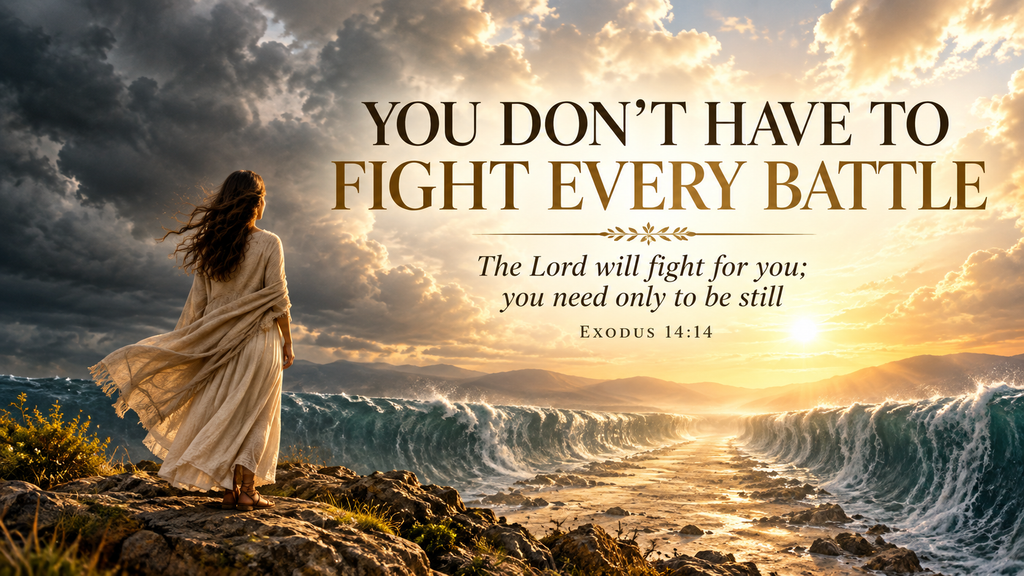
“The LORD shall fight for you, and ye shall hold your peace.” — Exodus 14:14 (KJV)
Have you ever reached the point where you simply did not know what else to do?
You prayed.
You tried to make things right.
You explained yourself.
You looked for solutions.
You replayed the situation in your mind again and again, wondering whether there was something else you could say, something else you could change, or one more thing you could do.
And yet the situation remained.
Sometimes the hardest battles are not the ones that require more effort.
They are the ones where we finally have to admit:
“God, I cannot fix this.”
Exodus 14:14 speaks directly into moments like these.
The Israelites were facing what appeared to be an impossible situation. The Red Sea was in front of them. Pharaoh’s army was approaching from behind.
There was nowhere obvious to run.
There was no human solution.
And in the middle of their fear, Moses told them:
“The LORD shall fight for you, and ye shall hold your peace.”
This verse does not mean that Christians should never take action or that every difficult situation will disappear without effort.
It teaches something deeper:
There are battles that cannot be won through panic, control, retaliation or human strength. Sometimes we must trust God with what is beyond our ability to change.
What Is Happening in Exodus 14?
To understand the meaning of Exodus 14:14, we need to understand the situation surrounding it.
God had delivered the Israelites from slavery in Egypt.
After repeatedly refusing to release them, Pharaoh finally allowed them to leave following the plagues that came upon Egypt.
But Pharaoh soon changed his mind.
He gathered his army and pursued the Israelites.
Then the Israelites found themselves trapped.
Behind them was Pharaoh’s army.
In front of them was the Red Sea.
From a human perspective, the situation looked hopeless.
And the people panicked.
They cried out to Moses and questioned why they had ever left Egypt.
But Moses responded:
“Fear ye not, stand still, and see the salvation of the LORD.” — Exodus 14:13
Then came the powerful words of Exodus 14:14:
“The LORD shall fight for you, and ye shall hold your peace.”
God was about to do something they could never have accomplished themselves.
He would make a way through the sea.
1. You Don’t Have to Fight Every Battle Yourself
Many of us live as though everything depends on us.
If something goes wrong, we immediately think:
How can I fix this?
What should I say?
How can I make them understand?
How can I control what happens next?
Taking responsibility for what we can change is important.
But there is a difference between responsibility and trying to control everything.
Some situations are simply beyond us.
You cannot control another person’s thoughts.
You cannot force someone to treat you fairly.
You cannot guarantee that every opportunity will work out.
You cannot predict every outcome.
And you cannot carry tomorrow’s problems today.
Exodus 14:14 reminds us that God does not expect us to possess His power.
There comes a point where we must stop fighting as though everything depends on us and begin trusting the One who sees what we cannot see.
Sometimes the battle exhausting you most is the one you were never meant to carry alone.
2. “The Lord Will Fight for You” Does Not Mean There Will Be No Battle
This distinction matters.
The Israelites still had an enemy pursuing them.
They still saw Pharaoh’s army.
They still felt afraid.
God’s presence did not mean there was no problem.
It meant the problem did not have the final word.
We sometimes assume that if God is with us, everything should immediately become easy.
Scripture repeatedly shows otherwise.
Faithful people still faced opposition, uncertainty, disappointment and frightening circumstances.
The promise is not that believers will never experience battles.
The promise is that we do not face them without God.
The presence of a battle does not mean the absence of God.
You may be in a season right now where you cannot understand what God is doing.
That does not mean He has abandoned you.
The Israelites could see the sea.
They could see Pharaoh.
What they could not yet see was the path God was about to create.
3. Being Still Does Not Mean Doing Nothing
One of the most important things about Exodus 14:14 appears immediately afterwards.
After Moses told the people to stand still and trust God, the Lord said:
“Wherefore criest thou unto me? speak unto the children of Israel, that they go forward.” — Exodus 14:15
First:
Do not panic.
Then:
Move forward.
That gives us a much fuller picture of biblical trust.
Being still does not necessarily mean sitting down and refusing to act.
It means refusing to allow fear to control your actions.
Sometimes faith means waiting.
Sometimes faith means speaking.
Sometimes faith means walking away.
Sometimes faith means apologising.
Sometimes faith means applying again.
Sometimes faith means setting a boundary.
And sometimes faith means doing absolutely nothing until God gives you clearer direction.
The important question is not:
“How do I regain control?”
It is:
“God, what would faithfulness look like here?”
Be still enough to hear God. Then move when He tells you to move.
4. Stop Trying to Control What Only God Can Change
One of the fastest ways to become emotionally exhausted is to continually fight things outside your control.
Perhaps someone misunderstands you.
You explain yourself once.
Then twice.
Then ten more times in your imagination.
Perhaps you are waiting for an opportunity.
You keep checking.
Worrying.
Predicting.
Planning every possible outcome.
Perhaps someone treated you unfairly and you desperately want them to acknowledge what they did.
But they may never do so.
There are things we can influence.
And there are things only God can change.
Knowing the difference can bring tremendous peace.
Ask yourself:
What has God actually placed in my hands today?
Perhaps your responsibility is to pray.
Perhaps it is to have one honest conversation.
Perhaps it is to make an application.
Perhaps it is to seek wise counsel.
Perhaps it is to forgive.
Perhaps it is simply to continue doing what is right.
Do that.
Then leave what you cannot control with God.
5. God Can Make a Way You Cannot See
Imagine standing where the Israelites stood.
Sea ahead.
Army behind.
There was no visible escape route.
If someone had asked them, “How are you getting out of this?” they would not have had an answer.
But their inability to see a solution did not mean God did not have one.
That is one of the most encouraging lessons in Exodus 14.
You do not need to see a way for God to make a way.
There will be seasons when you genuinely do not know what comes next.
You may not know how the situation will be resolved.
You may not know where the provision will come from.
You may not understand why one door closed.
You may not know why God allowed a particular disappointment.
Faith does not require pretending that you know.
Sometimes faith simply says:
“Lord, I don’t know what happens next, but I know You are still God.”
6. Fear Can Make You Want to Return to What God Brought You Out Of
There is another important lesson hidden in this story.
When the Israelites became afraid, they began talking about returning to Egypt.
Egypt had been a place of slavery.
Yet fear made their former captivity seem safer than their uncertain freedom.
We can sometimes do the same thing.
When moving forward becomes uncomfortable, we may become tempted to return to:
old habits,
unhealthy relationships,
familiar patterns,
comfortable compromises,
or situations God was helping us leave behind.
Familiarity does not always mean safety.
And difficult does not always mean wrong.
Sometimes the path God is leading you along feels uncertain simply because you have never walked it before.
Do not allow fear to rewrite your history.
Remember what God has already brought you through.
7. What Should You Do When You Cannot Fix the Situation?
When you find yourself facing your own “Red Sea moment,” try these six things.
First, tell God honestly what you are afraid of. You don’t need to pretend that everything is fine.
Second, separate what you can control from what you cannot. Take responsibility for your part without trying to become responsible for everything.
Third, resist fear-driven decisions. Panic often demands immediate action. Wisdom may tell you to wait.
Fourth, ask God for your next step rather than the entire plan. You may not need to know what happens six months from now. You may simply need today’s instruction.
Fifth, remember what God has already done. Past faithfulness can strengthen present trust.
Finally, leave the outcome with God. Obedience belongs to us. Ultimate control does not.
8. Your Red Sea Is Not Bigger Than God
When the Israelites looked at their circumstances, they saw impossibility.
When God looked at the same circumstances, He saw a place where His power would be displayed.
The sea eventually opened.
The Israelites crossed.
The thing that appeared to block their future became part of the story of their deliverance.
That does not mean every difficult situation in our lives will end exactly the way we imagine.
But it does mean we should be careful about declaring something hopeless simply because we cannot see a solution.
God’s ability is not limited by ours.
Your inability to fix something does not mean God has lost control of it.
Your confusion does not mean God is confused.
Your waiting does not mean God has forgotten.
And the battle in front of you is not bigger than the God who walks with you.
When You Feel Tired of Fighting
Maybe you needed Exodus 14:14 today because you are tired.
Tired of thinking about the same problem.
Tired of trying to persuade someone.
Tired of wondering how everything will work out.
Tired of carrying responsibilities that seem much bigger than your strength.
Perhaps God is not asking you to fight harder.
Perhaps He is inviting you to trust Him more deeply.
Do what He has placed in your hands.
Release what He has not.
Be still enough to hear Him.
And when He tells you to move forward, take the next step.
You may not yet see the road.
The Israelites didn’t either.
But God knew where the road would be.
A Prayer for When You Cannot Fix the Situation
Heavenly Father,
I am tired of trying to control things that are beyond me.
You know the situation I am facing and You know the fear, frustration and uncertainty I have been carrying.
Help me to recognise what You are asking me to do and what I need to surrender to You.
When I am tempted to panic, teach me to be still.
When I am tempted to fight in my own strength, remind me that You are with me.
Give me wisdom for the things I can change, patience for the things I cannot change and faith to trust You with the outcome.
Show me my next step and give me courage to move when You tell me to move.
Thank You that I do not have to carry every battle alone.
In Jesus’ name, Amen.
Remember This Today
You don’t have to fight every battle.
Some things require your action.
Some require your patience.
Some require your surrender.
And some require you to stand still long enough to remember:
“The LORD shall fight for you, and ye shall hold your peace.” — Exodus 14:14
You may not see the way forward yet. That does not mean God does not have one.
We recommend the following articles and also encourage you to check other articles which we know will bless you greatly.
I am adopted into God’s family
His mercies are new every morning
God is close to the broken-hearted