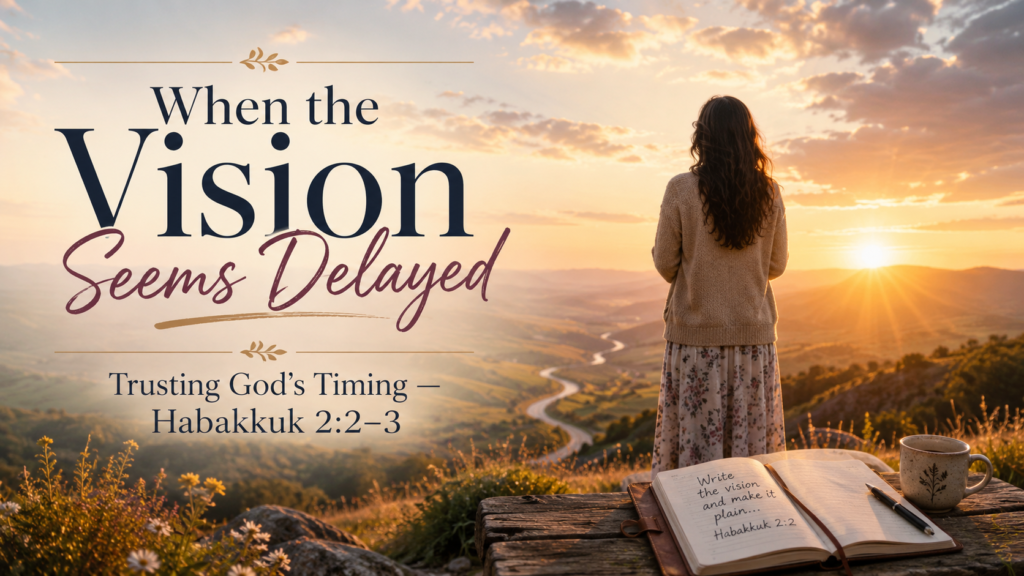
When the Vision Seems Delayed: Trusting God’s Appointed Time
There are seasons when God places something deeply within your heart—a dream, an assignment, a prayer, a business idea, a ministry, a family goal, or a new direction for your life.
At first, you may feel excited and full of faith. You can almost imagine the outcome. You believe something meaningful is about to happen.
Then the waiting begins.
Days turn into months. Months may turn into years. The opportunity does not come. The answer remains unclear. The progress you expected seems painfully slow.
You may begin to ask:
“Did I misunderstand God?”
“Have I missed my opportunity?”
“Why is nothing changing?”
“Has God forgotten what He showed me?”
Habakkuk 2:2–3 speaks directly to this kind of season. It reminds us that a vision can be genuine even when its fulfilment is not immediate. God’s silence does not always mean rejection, and delay does not automatically mean that the promise has disappeared.
The passage teaches us to make the vision clear, remain faithful to what God has shown us, and trust the appointed time.
Habakkuk Was Waiting for an Answer
The prophet Habakkuk lived during a confusing and troubling period. He looked around and saw violence, injustice, corruption, and suffering. He could not understand why God appeared to be allowing these things to continue.
Habakkuk brought his questions honestly before God.
He did not pretend that everything was fine. He did not hide his frustration behind religious language. He waited for God to answer him.
When the answer came, God instructed Habakkuk to write the vision clearly so that it could be understood and acted upon. God also warned him that the fulfilment would not happen immediately. The vision had an appointed time.
That message remains important for us today.
Sometimes God gives direction before He gives the full result. He may reveal the next step without revealing the complete journey. He may place a desire in your heart while allowing you to go through a season of preparation.
The waiting period does not mean that nothing is happening.
Write the Vision Clearly
God told Habakkuk to write the vision and make it plain.
Writing brings clarity.
A vision that remains only in your thoughts can easily become mixed with fear, emotion, distraction, and doubt. When you write it down, you are forced to think carefully about what you believe you have been called to do.
What exactly are you working toward?
Why does it matter?
Who will it help?
What steps can you take now?
Writing the vision does not mean creating a magical statement that forces God to give you everything you desire. Habakkuk 2:2–3 should not be treated as a formula for getting rich, becoming famous, or receiving every personal wish.
The passage is about receiving God’s direction and responding with faithfulness.
There is a difference between a vision inspired by purpose and a fantasy driven by comparison.
A God-centred vision is not merely about looking successful. It should produce obedience, service, growth, and positive impact. It may stretch you, humble you, and require more patience than you expected.
Writing the vision helps you separate what is truly important from what is merely attractive.
Clarity Helps You Keep Moving
The vision was to be written plainly so that the person reading it could run with it.
This suggests movement.
God was not telling Habakkuk to write the vision and then become completely passive. The written message was meant to guide action.
There are times when waiting on God means being still. There are also times when waiting means continuing to work faithfully while trusting Him with the outcome.
You can pray while learning.
You can wait while preparing.
You can trust God while improving your skills.
You can remain hopeful while taking responsible steps.
You can believe in the vision while accepting that the journey may require adjustment.
Suppose you believe God has placed a business idea in your heart. Trusting Him does not mean refusing to research the market, develop the product, improve your website, or learn how to reach customers.
Suppose you feel called to write a book. Faith does not replace the need to write, edit, revise, and complete the manuscript.
Suppose you are praying for a better job. You can continue praying while improving your CV, developing useful skills, and applying for suitable opportunities.
Faith is not an excuse for avoiding action. It gives us the courage to act without being controlled by fear.
The Vision Has an Appointed Time
One of the most powerful truths in Habakkuk 2:3 is that the vision has an appointed time.
The appointed time is different from our preferred time.
We often want the promise immediately. We create our own deadlines and then become disappointed when God does not follow them.
We may think:
“I should have achieved this by now.”
“My life should be further ahead.”
“Other people are already succeeding.”
“I have waited long enough.”
But God is not guided by social pressure, comparison, or our personal timelines. He sees what we cannot see. He knows what needs to be prepared within us and around us before certain doors open.
The right opportunity at the wrong time can become a burden.
A blessing received before we are ready may be difficult to manage. Greater visibility without strong character can lead to pride. Rapid business growth without proper systems can create confusion. A relationship entered out of desperation can bring unnecessary pain.
Sometimes the delay is not punishment. It is preparation.
God may be strengthening your character, increasing your wisdom, correcting your motives, or teaching you how to depend on Him.
He may also be arranging circumstances beyond your knowledge.
You may see an empty space, but God may see pieces that are still coming together.
Delay Does Not Always Mean Denial
When we have waited for a long time, it is easy to conclude that God has said no.
Sometimes His answer is no, and we must be willing to accept that. Not every idea, relationship, plan, or opportunity is part of His purpose for us.
However, a delay is not automatically a denial.
There are prayers that require patience. There are dreams that must mature. There are assignments that cannot be rushed.
The challenge is learning how to wait without allowing disappointment to destroy our faith.
Waiting becomes dangerous when we begin to make permanent conclusions based on temporary circumstances.
You may not see progress today, but that does not mean progress will never come.
You may not have the resources yet, but that does not mean they will never become available.
You may not understand the route, but that does not mean God has abandoned the destination.
Do not allow the silence of one season to convince you that God has stopped working.
What Should You Do While You Wait?
Waiting for God’s timing does not mean putting your life on hold. It means living faithfully in the present while trusting Him with the future.
1. Return to what God showed you
When doubt grows louder, return to the original vision.
Ask yourself whether the goal still reflects God’s character and purpose. Remember why you started. Review what you wrote down and pray for fresh clarity.
You may discover that the vision remains the same, but your method needs to change.
2. Take the next responsible step
You do not need to understand the entire journey before moving forward.
Focus on the next step you can take with wisdom and integrity. Small acts of obedience can prepare the way for larger opportunities.
Do not despise slow progress. Consistency often produces results that excitement alone cannot sustain.
3. Allow God to develop you
Instead of asking only, “When will this happen?” also ask, “Who am I becoming while I wait?”
The waiting season can teach patience, discipline, humility, courage, and discernment.
These qualities may become more valuable than the achievement itself.
4. Stop measuring your life against other people
Comparison creates artificial deadlines.
Someone else’s success does not mean you have failed. Their season is not your schedule. Their opportunity does not cancel what God can do through your life.
Celebrate others without using their progress as evidence against yourself.
5. Remain open to God’s correction
Sometimes the vision needs refinement.
God may change the route, remove an unhealthy motive, close a particular door, or lead you toward something better than your original plan.
Faithfulness is not stubbornly demanding your own way. It is remaining committed to God even when He changes your direction.
Do Not Force What God Has Not Released
Waiting can make us impatient, and impatience can lead us to force opportunities.
We may accept the wrong offer because we are tired of waiting. We may enter an unhealthy relationship because we fear being alone. We may spend money we cannot afford because we want rapid results. We may compromise our values because a shortcut appears to promise success.
But anything you must disobey God to obtain is not worth having.
There is a difference between taking bold action and forcing an outcome.
Bold action is guided by faith, wisdom, and integrity. Forcing an outcome is usually driven by fear, pride, or desperation.
When you trust God’s timing, you do not have to manipulate people, exaggerate your abilities, or abandon your principles.
What God has truly appointed for you will not require you to become dishonest in order to receive it.
When the Vision Seems to Be Dying
Some seasons feel worse than ordinary delays. The vision may appear completely impossible.
The business may be struggling. The application may have been rejected. The relationship may have ended. The financial support may not have arrived. The opportunity you expected may have gone to someone else.
In those moments, faith does not mean pretending that you are not disappointed.
Habakkuk himself brought difficult questions to God.
You can be honest about your pain while still choosing to trust Him.
Say to God:
“I do not understand what is happening, but I do not want disappointment to lead me away from You.”
“Show me whether I should continue, adjust, pause, or release this vision.”
“Help me recognise the difference between a difficult season and a closed door.”
Sometimes God restores the original vision. Sometimes He redirects it. Sometimes what appears to be an ending becomes the beginning of something you could not previously imagine.
Our confidence should not rest only in receiving a particular outcome. It must rest in the character of God.
The Waiting Season Still Has Purpose
It is easy to believe that life will begin when the vision is fulfilled.
You may think you will finally become joyful when the business succeeds, when the prayer is answered, when the right person arrives, or when the door opens.
But your present season is also part of your life.
Do not become so focused on tomorrow that you overlook what God is doing today.
There are people you can encourage now.
There are skills you can develop now.
There are prayers you can pray now.
There are small opportunities you can appreciate now.
There are lessons you can learn now.
The waiting room is not an empty place when God is present in it.
Trust the One Who Gave the Vision
Habakkuk 2:2–3 ultimately directs our attention beyond the vision to the God who speaks.
The vision is important, but God is greater than the vision.
Your dream should never become more important than your relationship with Him. Your faith should not depend entirely on whether life unfolds exactly as you planned.
God remains faithful even when the route is unfamiliar.
He remains present when progress is difficult to see.
He remains wise when His timing challenges your patience.
He remains good when you do not yet understand the outcome.
The vision may seem delayed, but God is not careless with your life.
Continue to pray. Continue to prepare. Continue to obey. Continue to grow.
Write the vision clearly, but hold your plans with open hands.
Work faithfully, but do not worship the result.
Wait expectantly, but do not force the timing.
At the appointed time, God’s purpose will become clearer. And even when the fulfilment looks different from what you first imagined, you can trust Him to lead you toward what is right.
A Prayer for the Waiting Season
Heavenly Father,
Thank You for the dreams, desires, and assignments You place within our hearts. When the vision seems delayed, help us not to become discouraged or impatient.
Give us clarity to understand what You are asking us to do. Give us discipline to take the right steps and wisdom to avoid forcing doors You have not opened.
Protect us from comparison, fear, and desperation. Teach us to trust Your appointed time instead of demanding our own.
Use this waiting season to strengthen our character, deepen our faith, and prepare us for what lies ahead.
When we need to continue, give us endurance. When we need to adjust, give us humility. When we need to release something, give us courage.
Above all, help us trust You more than we trust our plans.
In Jesus’ name, amen.
Final Encouragement
The fact that you are still waiting does not mean your faith has failed.
Keep the vision before you. Remain open to God’s guidance. Take the next faithful step and allow Him to determine the timing.
What appears slow to you may still be moving according to God’s purpose.
The vision has an appointed time.
Until then, remain faithful.
You may also like the following articles:
How to stop living in fear – 2 Timothy 1:7
Dead things can come alive – John 11:43-44
How to have faith when you can see what God is doing
Don’t give up on God because He is working according to His own schedule and His timing is always perfect.